


In the past, national security was primarily concerned with protecting physical borders, military bases, and critical infrastructure. In the modern digital era, as societies become increasingly dependent on digital technologies, national security is extending beyond territorial defense. So data, digital infrastructure, and cyberspace have become strategic national assets. The cyberattacks increasingly target on financial systems, grid energy, telecommunication networks, and government services and can be as damaging as traditional attacks. “A nation’s stability and resilience now depend on protecting digital assets like cloud systems, communication networks, and critical infrastructure from emerging cyber threats.” So now cybersecurity is an essential part of modern national security. It has now become a broader spectrum of national security.
Digital Asset Protection
Digital asset protection is a comprehensive strategy for securing an entire digital environment including information systems, and technological resources from unauthorized access, theft, damage, misuse, loss, or cyberattacks. It is not just about installing security tools, but about building a complete strategy that safeguards digital trust and continuity.
In recent years, this approach has evolved from a reactive ‘firefighting’ mindset to a more proactive and resilience-driven strategy. Instead of responding to incidents after they happen, organizations are now working to predict, prevent, and quickly recover from cyber threats. With the rise of artificial intelligence, cyber threats are becoming more automated, adaptive, and difficult to detect using traditional methods. In today’s highly interconnected world, where cloud services and global supply chains are deeply integrated, the traditional “set it and forget it” approach to cybersecurity is no longer enough. Moreover, organizations must adopt a forward-looking strategy that prioritizes continuous monitoring, adaptive defenses, and long-term digital resilience and intelligence-driven defense have become essential. As a result, Security Operations Centers (SOCs) are gradually evolving into more intelligent and automated defense systems. In this regard, AI plays a central role in identifying unusual behavior and detecting threats in real time and also helps to mitigate those threats.
Furthermore, increasing cybercrime incidents, weak government systems, cybersecurity awareness, and limited technical capacity have made cybersecurity a growing national concern, particularly for critical infrastructure. This guide highlights the critical security controls necessary to safeguard digital assets whether they encompass intellectual property, customer data, financial information, or brand reputation. It also explores the role of cybersecurity controls in securing the nation’s digital ecosystem. Furthermore, it examines preventive, detective, and corrective controls in the context of international frameworks such as ISO/IEC 27001 and the NIST Cybersecurity Framework, emphasizing the need for localization. By understanding and implementing these controls, organizations can anticipate emerging threats, minimize risk exposure, and ensure the continuity and integrity of their digital operations
Nepal’s Digital Transformation Landscape
In recent years, the rapid growth in internet connectivity, digital banking systems, and online government services has significantly enhanced Nepal’s digital transformation. These innovations have improved the delivery of public services, financial inclusion, and efficiency of governance and also enhanced the convenience of citizens’ daily lives
However, as the nation becomes increasingly dependent on digital technologies, cybersecurity risks are also growing rapidly. Also, critical national digital assets, including government systems, financial platforms, telecommunication networks, energy infrastructure, and citizen data, are becoming the most valuable targets for emerging cyber threats.
Furthermore, these challenges are further enhanced risk by the fragmented digital systems, limited cybersecurity readiness, and insufficient coordination among different bodies and stakeholders. As Nepal continues its digital transformation journey, strengthening cybersecurity and protecting national digital assets have become essential priorities.
Digital Assets and Their Classification
Digital assets are representing any data, system, or digital resource that holds value for an organization, society, and individual.
Digital assets form the backbone of modern enterprise operations that drive productivity, innovation, and service delivery.
Although they are crucial, many organizations still struggle to have a complete picture of their IT asset landscape. This lack of visibility often leads to unnecessary costs, compliance risks and operational inefficiencies.
From a cybersecurity perspective, unmanaged or unknown assets significantly increase the cyberattack, increasing the threat exposure for organizations. However, most of the organizations do not have real-time visibility of their asset inventory and do not have structured strategies for asset lifecycle management, including secure disposal.
The IT landscape is changing with the growth of emerging technologies like artificial intelligence, cloud computing and distributed systems, and the need for proper management of IT assets has now become essential in this domain. It has become a foundational capability for ensuring operational efficiency, regulatory compliance, and cyber resilience.
Digital Assets Categories
a) Information/Data Assets: Information assets include all types of information and data that are generated, processed, stored, or transmitted by an organization during its operations. Information assets must be managed based on principles of confidentiality, integrity, and availability to ensure compliance with relevant laws, regulations, and information security standards.
• Personal Data: This refers to information pertaining to identified or identifiable individuals, such as citizens, employees, and service users.
• Government Classified Data: This includes information classified as confidential, secret, or top secret according to existing government classification systems/framework.
• Financial and Transactional Records: These comprise budgetary information, accounting records, transaction data, procurement documents, and audit reports.
• Health Records: This category includes medical, biometric, and health-related data that necessitate stringent privacy and protection measures.
• Intellectual Property: This encompasses patents, copyrights, trade secrets, software source code, research outputs, and proprietary methodologies.
• Sensitive and Classified Information: This refers to any information whose unauthorized disclosure, alteration, or destruction could negatively affect national security, public trust, or organizational operations.
b) Technological Assets: Technological assets include all information technology resources that are used to support organizational operations and service delivery. Technological assets include, but are not limited to:
• Servers: On-premises, virtualized, and cloud-hosted servers used for application hosting, data processing, and service delivery.
• Networks: Local Area Networks (LAN), Wide Area Networks (WAN), internet connectivity, and secure communication channels.
• Software and Applications: Custom-developed applications and Commercial Off-The-Shelf (COTS) software supporting business and government operations.
• Cloud Platforms: Cloud-based Infrastructure as a Service (IaaS), Platform as a Service (PaaS), and Software as a Service (SaaS) environments.
• End-User Devices: Desktop computers, laptops, mobile devices, tablets, and Internet of Things (IoT) devices used by employees and stakeholders.
• Network Infrastructure: Routers, switches, firewalls, load balancers, and other networking equipment essential for secure data transmission.
• Databases and Data Repositories: Structured and unstructured databases storing operational, administrative, and sensitive information.
c) Digital Identity Assets: Identity assets refers to the digital identities and associated credentials employed to authenticate users, systems, and services. Identity assets provide the basis for authorizing access to information assets and technological assets. Compromise of identity assets may lead to unauthorized access, data breaches, and systemic security failures.
• User Credentials: Usernames, passwords, PINs, biometric identifiers, and multi-factor authentication (MFA) secrets.
• Cryptographic Keys: Symmetric and asymmetric keys used for encryption, decryption, digital signatures, and secure communications.
• Digital Certificates: Public key infrastructure (PKI) certificates used for identity verification, secure transactions, and system trust.
• Privileged Access Accounts: Administrator, root, and other high-privilege accounts with elevated system or application access rights.
• API Keys and Tokens: Keys, secrets, and tokens used to authenticate and authorize application-to-application communication.
• Service Accounts: Non-human accounts used by applications, services, and automated processes to access systems and data
Therefore, security breaches of digital assets could result in financial losses, reputational damage, legal problems, and, in the case of government, even threaten the whole nation’s security. Security of digital assets, thus, is not only a technical problem but also a national strategic issue.
Cyber Threat Landscape in Nepal
Nepal’s cyber threat landscape is increasing rapidly as more public services, financial systems, and daily activities shift to online. The growth of digital payment platforms such as eSewa, Khalti, and connectIPS and the increasing adoption of the Nagarik App and other e-governance services are rapidly expanding Nepal’s digital ecosystem. This dependence on the digital world has exposed to many cybersecurity threats that can compromise the protection of digital assets such as sensitive data, disrupt services, and undermine confidence in digital systems.
• Ransomware attacks: Ransomware attacks are increasingly targeting government and financial institutions.
• Data breaches: Compromising sensitive citizen and institutional data
• Phishing and social engineering: Exploiting human vulnerabilities
• Distributed Denial of Service (DDoS): Attacks overwhelm websites or services with traffic, causing them to crash and become unavailable to users.
• Critical infrastructure attacks: Interrupting essential services such as telecommunications, grid energy, transportation, and healthcare etc
• Supply Chain Attacks: Attackers who target software vendors, service providers or third party suppliers can potentially gain access to many organizations at the same time.
• Social media scams
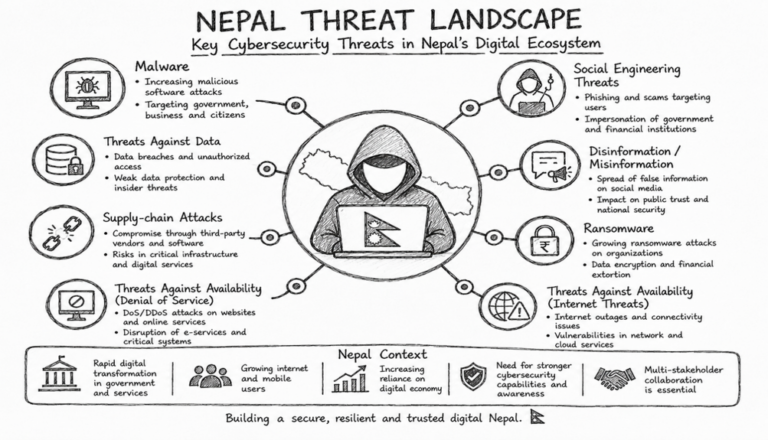
Fig: Figure 1 illustrates the major cyber threats affecting Nepal’s digital ecosystem, highlighting ransomware, phishing, data breaches, DDoS attacks, social engineering, and attacks targeting critical infrastructure.
According to ENISA’s Cyber Threat Landscape Report (2022), ransomware remains one of the most damaging cyber threats globally.
International Cybersecurity Frameworks
A cybersecurity framework refers to a well-organized set of policies, procedures, day-to-day practices, and technological measures, primarily intended to establish a comprehensive and resilient posture for security. It uses a detailed mechanism that enables organizations to manage their cybersecurity risks and comply with legal and regulatory requirements. Globally recognized frameworks provide structured approaches to cybersecurity implementation. Excellent implementation of such frameworks lessens the risks of cyber threats, thereby ensuring fewer cyber threats resulting in potential data breaches and business disruptions.
Additionally, internationally accepted frameworks that provide guidelines on the implementation of the measures and cybersecurity controls. These frameworks are accepted globally, and they include the NIST Cybersecurity Framework, ISO/IEC 27001, ISO/IEC 27001:2022, as well as Critical Security Controls (CIS), etc. These frameworks are useful for guidance, but Nepal needs to adapt them to local contexts, including resource constraints, institutional capacity and regulatory environments.
a) ISO/IEC 27001:2022
ISO/IEC 27001 is an internationally recognized standard published by the International Organization for Standardization (or ISO). It is the latest revision of the international standard that specifies requirements for establishing, implementing, maintaining, and continually improving an Information Security Management System (ISMS) to protect against the root causes of information security risks. It is based on a risk management approach to information security. Accordingly, it helps the organization to systematically identify, evaluate, and control the risks to the confidentiality, integrity, and availability of information assets.
b) NIST Cybersecurity Framework (CSF)
The National Institute of Standards and Technology Cybersecurity Framework (NIST CSF 2.0) provides practical and flexible guidance for organizations to manage cybersecurity risks in a structured way. The NIST Cybersecurity Framework (CSF) offers risk-based, technology-neutral guidance to organizations across industries, government agencies, and other institutions for managing cybersecurity risks. The NIST Cybersecurity Framework (CSF 2.0) offers a flexible, outcomes-based approach to risk management by identifying and applying high-level cybersecurity outcomes across a wide variety of organizational settings, and by leveraging external resources to support detailed implementation guidance.
NIST CSF 2.0 enables organizations to more effectively identify risks, protect critical infrastructure and data, detect cyber threats, respond to incidents and recover from disruptions. The framework also encourages organizations to improve their cybersecurity practices over time, in accordance with globally recognized standards and best practices.


c) Center for Internet Security (CIS)
The Center for Internet Security (CIS) publishes the CIS Critical Security Controls (CIS Controls), a globally recognized set of best practices designed to help organizations defend against the most prevalent and impactful cyber threats. The CIS Critical Security Controls (CIS Controls) Framework provides a prescriptive, prioritized, and simplified set of best practices that you can use to strengthen your cybersecurity posture.
Understanding Cybersecurity Controls-Control Taxonomy (Three-Layer Model)
Cybersecurity controls are safeguards designed to reduce risks by protecting systems, networks, and data from cyber threats. These controls operate across technical, administrative, and physical domains, and by integrating them, the risk is reduced and the core security objectives of confidentiality, integrity, and availability (CIA triad) are supported.
Cybersecurity controls are policies, procedures, technologies, and physical safeguards designed to reduce cyber risks to acceptable levels. They protect systems and data by ensuring the following:
• Confidentiality: Information is accessed only by authorized entities
• Integrity: Information remains accurate and unaltered
• Availability: Systems and data are accessible when required
• Authenticity and Accountability: Actions and identities can be verified
a) Administrative (Managerial) Controls-– The Governance Layer
Administrative controls establish an organizational foundation for effective cyber security. They define governance, information security policies, risk management frameworks, incident response policy/plans, data classification and handling policy, cryptography policy, backup & retention Policy, security awareness programs, and human resources that guide cybersecurity efforts. Effective governance ensures accountability, leadership involvement, and alignment between cybersecurity objectives and organizational strategies.
Risk based decision-making, as advocated by standards such as ISO/IEC 27001, enables organizations to prioritize controls based on threat likelihood and potential impact, which includes:
• Information security policies and standards
• Risk assessment and risk treatment processes
• Access control and data classification policies
• Incident response and disaster recovery plans
• Security awareness and training programs
• Third-party and supply-chain security requirements
b) Technical (Logical) Controls: The Enforcement Layer
Technical controls play a vital role in protecting organizations’ assets from modern cyber threats by providing real-time security and reducing opportunities for attackers to exploit systems. These controls are implemented through hardware and software solutions that automatically enforce security policies, monitor unusual activities, and detect suspicious behavior before significant damage occurs, including:
• Identity and Access Management (IAM) systems
• Multi-Factor Authentication (MFA)
• Privileged access management (PAM)
• Network security controls such as Firewalls, IDS/IPS, and network segmentation
• Endpoint protection (AV, EDR, XDR) and application security solutions
• Encryption of data at rest and in transit
• Security monitoring using SIEM and SOC operations
• Secure configuration, patch management, and vulnerability scanning
c) Physical Controls: The Foundation Layer
Physical controls protect the tangible infrastructure that hosts digital systems. Physical security breaches can directly lead to digital compromise, making these controls essential for safeguarding digital assets. Secure facilities, controlled access to server rooms, surveillance systems, and environmental protections, such as fire suppression and power redundancy, remain essential components of comprehensive digital asset protection, which includes
• Secure facilities and controlled entry points
• CCTV and surveillance systems
• Server room security and restricted access
• Environmental controls such as fire suppression, UPS, and cooling
• Digital asset tagging
• Secure asset disposal and hardware lifecycle management
• Hardware inventory, Chain-of-custody controls
Functional Types of Cybersecurity Controls: Security Lifecycle
Cybersecurity controls can be categorized not only by technical domain but also by functional roles across the security life cycle. This lifecycle perspective enables organizations to understand how different controls work together to prevent incidents, detect threats, respond effectively, and recover securely. From an operational perspective, cybersecurity controls have different functions in the security lifecycle.
• Preventive Controls: Preventive controls are designed to reduce vulnerabilities and prevent cyber incidents before they occur. (For example: MFA, Data encryption and secure communication protocols, Network segmentation and firewall implementation, Security awareness)
• Detective Controls: Detective controls focus on identifying and monitoring threats in real time. Identify incidents and alert on security events in real time (For example: logs analysis, Security Information and Event Management (SIEM) systems alerts,, IDS/IPS and File integrity monitoring)
• Corrective Controls: Corrective controls helps to ensure effective response and recovery following an incident. Limit the damage and remove threats (e.g., Incident response planning and execution, Backup and disaster recovery systems, post-incident analysis and system restoration, Malware removal, Patching vulnerabilities, Business Continuity Planning (BCP))
An understanding of cybersecurity controls with a security lifecycle approach enables an organization to develop a well-rounded defense strategy. There is a specific role for every type of functional control, and skipping any one of these can increase risk to an organization. A mature cybersecurity posture includes a combination of all four types of functional control, which continues to evolve with changing threats and operational requirements. An effective security architecture integrates all four types of control, which is essential for defense-in-depth.
Best Practices for Cybersecurity Protection
a) Identity and Access Management (IAM)
Identity and Access Management ensures that access to systems and data is limited to authorized users and entities. Key IAM controls include authentication mechanisms, such as passwords and multi-factor authentication; authorization models, such as role-based or attribute-based access control; and identity lifecycle management. Identity and Access Management (IAM) is increasingly viewed as the new security perimeter, particularly in cloud and remote work environments, where traditional network boundaries are insufficient.
b) Network Security Controls
Network security controls protect digital infrastructure through layered defenses like firewalls, Intrusion Detection and Prevention System (IDPS), and segmentation, which filter traffic and manage access to prevent unauthorized, potentially destructive entry. By adopting the Zero Trust model, an organization enforces continuous verification, where no user or device is trusted by default. It means context-aware verification for all users, regardless of location, to minimize the attack surface. These controls are essential for securing critical data against sophisticated threats, ultimately reducing the risk and limiting lateral movement in the event of a breach.
Core Network Security Components:
• Firewalls & IDPS: Firewalls filter traffic based on security rules, while IDPS (Intrusion Detection and Prevention Systems) monitor for, detect, and prevent malicious activity at network boundaries or on hosts.
• Network Segmentation: This technique involves isolating parts of the network to contain breaches and prevent lateral movement by attackers.
• Zero Trust Architecture (ZTA): A “never trust, always verify” approach that grants access based on strict, context-aware policies (e.g., user identity, device health) rather than location.
• Access Controls: Utilizing tools like Identity and Access Management (IAM) to ensure only authorized users access specific resources, enforcing the principle of least privilege.
• Encryption: Protects data integrity and confidentiality during transmission, ensuring that intercepted data cannot be read.
c) Endpoint Security Controls
Endpoint security protects devices such as computers, laptops, servers, and mobile devices are frequent targets of cyberattacks. Endpoint security controls include antivirus software, endpoint detection and response (EDR) solutions, patch management, and device encryption. As endpoints often serve as entry points for attackers, continuous monitoring and rapid remediation are essential for ensuring endpoint security.
d) Data Security Controls
Data security controls are primarily concerned with ensuring the security of data throughout its lifecycle, including when data is at rest, in transit, or being used. Encryption, data classification, and data loss prevention are of primary importance in ensuring the confidentiality and integrity of data, especially with regard to data protection and privacy regulations.
e) Application Security Controls
Applications are one of the major gateways for cyberattacks, often due to code-level vulnerabilities, insecure third-party libraries, and misconfigurations. Because they are such a frequent vector for cyberattacks because of vulnerabilities in the code or third-party components.
To mitigate these risks, for an organization, there is a need to shift to the “security left” paradigm, which means that security should be embedded at every step of development, including secure coding, code reviews, and Vulnerability Assessment and Penetration Testing (VAPT) scans (SAST/DAST/IAST), which should be carried out throughout the lifecycle when a new version will be released; it is not just at the end.
Ultimately, by prioritizing secure development and continuous testing and code reviews, an organization can catch and fix vulnerabilities early drastically reducing risks before the application ever goes deployment
f) Security Monitoring and Detection: Security Information and Event Management (SIEM)
Security Information and Event Management (SIEM) is this centralized security platform that gathers, normalizes, then basically looks at logs from endpoints, servers, firewalls, applications, and cloud environments. It supports real-time threat detection, keeps incident response moving, and helps with forensic analysis, plus compliance monitoring, all by doing log correlation and analytics.
Furthermore, SIEM solutions like Splunk Enterprise Security, IBM QRadar, and Microsoft Sentinel are mentioned a lot. There are also open-source options, for example, Wazuh, Security Onion, ELK Stack, AlienVault OSSIM, Graylog, and OpenSearch, which people sometimes choose for more flexibility or budget limitations.
Nowadays, SIEM platforms tend to add machine learning, User and Entity Behavior Analytics (UEBA), and threat intelligence connections. Together these features help identify insider threats, credential misuse, and more sophisticated attacks. When emergency response teams minimize Mean Time to Detect (MTTD) and Mean Time to Respond (MTTR), SIEM ends up improving cyber resilience across the organization and reducing the damage from security incidents in a pretty direct way.
g) Incident Response and Recovery Controls
A strong national Computer Emergency Response Team (CERT) should be the central body responsible for securing critical infrastructure, government networks, and the digital economy from cyber threats. It serves as the nation’s focal point for incident management, vulnerability coordination, and cybersecurity awareness
Incident response and recovery controls are critical components of a strong cybersecurity framework, which is designed to effectively detect incidents, respond to them, and recover from security events. Incident response controls include documented procedures, trained response teams, forensic tools, and backup and recovery systems. A structured incident response lifecycle, including preparation, detection, containment, eradication, recovery, and lessons learned, ensures organizational resilience and continuous improvement.
Artificial Intelligence and Cybersecurity
Artificial Intelligence (AI) is revolutionizing the field of cybersecurity by enhancing its ability to quickly and accurately identify, prevent, and respond to cyber threats. AI methods facilitate the analysis of vast amounts of security data, uncover abnormal patterns, and assist security personnel in recognizing potential attacks before they inflict significant harm.
Technologies based on AI, including machine learning, deep learning, and natural language processing (NLP), enable systems to learn from previous incidents and adapt to new threats. AI finds extensive application in various cybersecurity processes such as threat detection, deepfake detection, phishing prevention, behavioral analytics, endpoint protection, network security, and identity and access management. AI can oversee user behaviors and network activities to identify suspicious actions, minimize false positives, and enhance incident response efficiency. It can also automatically separate compromised digital assets and block them.
Generative AI is quickly taking on two roles in the realm of cybersecurity. While malicious actors can use it to develop advanced phishing schemes, malware, and social engineering tactics, similarly, defenders can utilize the same technology to boost threat intelligence, streamline security operations, and strengthen cyber defense measures. As cyber threats keep advancing, AI is increasingly becoming a vital part of modern cybersecurity strategies.
Legal, Regulatory, and Institutional Framework
Cybersecurity regulatory and legal compliance refers to an organization’s responsibility to follow laws, regulations, guidelines, and industry standards that governed to protect digital assets and ensure the secure use of network, applications, information systems and security controls. Regulatory compliance mainly involves meeting requirements established by governments, international organizations, and industry specific frameworks. Legal compliance, on the other hand, focuses on adhering to national and international laws related to data privacy, data protection, security measures and the prevention of cybercrime.
Additionally, when organizations integrate these compliance requirements into their daily operations and security practices, they meet legal obligations also strengthen their overall cybersecurity posture. A well-planned compliance strategy helps organizations identify security gaps, reduce cyber risks, build trust among users and stakeholders, and avoid financial penalties or legal consequences resulting from non-compliance.
Furthermore, important regulations and laws include the General Data Protection Regulation (GDPR) concerning data privacy in the European Union; HIPAA, which establishes standards to safeguard healthcare information in the United States; and PCI DSS, which specifies security measures for organizations processing payment card data, as well as international standards such as ISO/IEC 27001 and NIST, which compel organizations to adopt security frameworks to address risks, protect sensitive data, and ensure the confidentiality, integrity, and availability of information, and several national cybersecurity laws that outline organizational responsibilities for breach reporting and secure digital practices.
Institutional and Policy Implication
Strong institutions, clear responsibilities, and cooperation among all stakeholders are critical to effective cybersecurity governance. In Nepal, the National Cyber Security Center (NCSC), established in early 2024 (2080-10-09 BS), is playing an important role in improving the cybersecurity posture. It acts as a central body for coordinating cybersecurity activities, strengthening preparedness, and helping protect the digital space from emerging cyber threats.
The NCSC is closely working with government agencies, critical infrastructure sectors, and other stakeholders to improve national cybersecurity efforts. It helps and supports building cybersecurity policies, standards, and guidelines to encourage consistent security practices across different sectors. In addition, the center assists in security audits, security operation centers for threat monitoring, and cyber incident detection, response, and recovery to reduce disruption and improve national cyber resilience.
Furthermore, National Cyber Security Center is working on important activities for enhancing a National Security Operation Center (SOC) vision, building national Computer Emergency Response Team (CERT) capabilities, improving threat intelligence sharing mechanisms, protecting critical infrastructure, establishing digital forensics, conducting regular cyber drills, expanding cybersecurity awareness and cyber incident management frameworks. NCSC is also playing a strategic role in advancing national cyber resilience by focusing on a preventive and AI-driven cybersecurity approach to make it more effective. These initiatives help strengthen Nepal’s preparedness against cyber threats while supporting secure and resilient digital development.
Cybersecurity and Digital Sovereignty
Digital sovereignty represents the capability of controlling, securing, and governing its own data, technologies, cyberspace, and digital infrastructure. Similarly, just as territorial sovereignty ensures the protection of territorial borders for a particular state, digital sovereignty protects the interests and digital capabilities of a particular country. As Nepal continues to be increasingly dependent on foreign-owned clouds services and digital platforms, there will be a need for digital sovereignty.
In addition, cybersecurity and digital sovereignty complement each other in defining the ability of a state to ensure its cybersecurity and governance of its digital environment. In terms of digital sovereignty, it encompasses critical information infrastructures, governmental information systems, data, and technological resources necessary for conducting socioeconomic activity. Thus, with Nepal having entered a new phase of digital transformation and adoption of technologies, the issue of digital sovereignty has become crucial for the country. It ensures that its vital digital resources remain secure and resilient, allowing the country to maintain national governance of these resources. That is why the question of digital sovereignty is a fundamental pillar of national security, citizen privacy, economic resilience, and long-term strategic independence, not merely a question of technology and national policy.
Capacity Building and Awareness
In a digitally connected world, capacity building and public awareness are essential for effective cybersecurity, especially when human behavior often determines whether systems remain secure or become vulnerable. As advanced technology becomes more prevalent, many cyber incidents still occur due to simple human mistakes such as weak passwords, falling for phishing emails, or mishandling sensitive information. So, one of the most important sources of empowerment is human factors.
Additionally, developing skilled cybersecurity professionals and experts who can understand, prevent, and respond to evolving threats in cyberspace. Since cyber risks are constantly changing day to day, continuous training is necessary. This helps them stay prepared and capable of defending complex digital infrastructures.
Besides professional development, awareness plays a crucial role, promoting cyber hygiene is another key step. Basic practices like using strong and unique passwords, enabling two-factor authentication, updating software regularly, and avoiding suspicious links significantly reduce cyber risks. These habits form the first line of defense against cyber threats. Ultimately, the end goal is to create a sustainable culture of cybersecurity awareness. When awareness becomes part of everyday behavior, security improves across each level of society.
Emerging Technologies and Future Cybersecurity Challenges
The rapid growth of digital technologies such as artificial intelligence (AI), cloud computing, the Internet of Things (IoT), 5G, and blockchain is transforming how governments, businesses, and individuals operate. While these technologies improve efficiency, innovation, and service delivery, they also introduce new and emerging cybersecurity risks and expand the attack surface for cybercriminals.
As Nepal continues its digital transformation through e-governance, digital banking, and online services, protecting digital assets has become increasingly important. Cyber threats such as ransomware, phishing, data breaches, and supply chain attacks are becoming more advanced and can significantly impact critical infrastructure, economic stability, and citizen trust.
Additionally, to address these challenges, cybersecurity is evolving toward more proactive and resilient approaches, including Zero Trust Architecture, AI-driven threat detection, cloud security, Security Operations Centers (SOCs), threat intelligence sharing, and automated incident response. Organizations must also prepare for emerging risks related to IoT devices, ransomware, and future technologies such as quantum computing.
Furthermore, in the future, quantum computing may cause a risk to current encryption algorithms, and we may need to adopt quantum-safe cryptography. At the same time, blockchain technologies, through distributed ledger systems, provide secure and transparent means to manage digital transactions within a network but also bring about risks in terms of implementation and governance.
For Nepal, these developments highlight the need for stronger cybersecurity governance, protection of critical infrastructure, workforce development, threat intelligence sharing, investment in cyber resilience, and well-defined cloud security policies. Preparing for emerging technologies today will help ensure a secure and trustworthy digital future for the nation by supporting sustainable digital development.
Overall, Nepal’s cybersecurity approach is shifting from basic protection to a more resilient and response-driven model, ensuring that essential services, banking, communication, and government platforms need to remain operational even during cyber incidents.
At the global and national levels, cybersecurity controls are also evolving toward more advanced and integrated approaches such as
• Identity-focused Zero Trust Architecture
• AI-driven threat detection and automated response
• National Security Operations Centers (SOCs) with threat intelligence sharing
• Ransomware evolution and AI-powered cyber extortion defense
• SASE and XDR integration for unified security
• API and supply chain security protection
• Readiness for post-quantum cryptography
• Identity Threat Detection and Response (ITDR)
• Continuous Threat Exposure Management (CTEM)
• Security automation and orchestration (SOAR)
• Strong digital forensics and incident response readiness
• Cloud security strengthening and Addressing IoT security vulnerabilities
• Privacy-by-design and security-by-design principles
Challenges in Implementing Cybersecurity Controls
Implementing effective cybersecurity controls is a critical step toward protecting digital assets. Despite their importance, implementing these controls presents challenges such as effective law, limited resources, system complexity, skilled manpower, and user resistance. Additionally, rapidly evolving threats can outpace traditional mechanisms. Addressing these challenges requires risk-based prioritization, continuous training, executive support, and integration of security into the organizational culture. Generally, organizations often struggle due to the following reasons:
• Over-reliance on tools without governance
• Poor asset visibility and inventory management
• Weak identity and access controls
• Lack of trained personnel and awareness
• Ignoring third-party and supply-chain risks
Strategic Recommendations
To enhance cybersecurity in Nepal, there is a need for a transformation from a reactive to a proactive approach regarding national security matters. The rapid digitization of operations in both the government sector and private entities cannot understate the importance of securing sensitive digital information, citizen data, and other critical infrastructures. One way of achieving this can be done through the creation of a comprehensive multilayer framework comprised of updated cybersecurity laws and deployment of sophisticated technologies like threat intelligence software and secure network architecture, among others. Through the integration of the above elements, Nepal will have created a robust digital environment capable of detecting, mitigating, and responding to emerging cyber threats before they cause unalterable harm to national security and public trust.
Moreover, achieving the vision ultimately relies on human resources, which means investing heavily in employees’ training, launching public awareness campaigns, and modernizing our legal acts and framework regarding privacy and cybercrime. Finally, by establishing a dedicated research unit to study emerging tech and evolving risks, Nepal can confidently anticipate future threats and secure a trusted digital ecosystem.
Conclusion
In conclusion, the future of cyberspace cannot be secured by investing in technology and proper infrastructure alone. To ensure the security of a country’s critical national digital assets, it needs to establish effective laws, a strong cybersecurity culture, and skilled human resources. Furthermore, there should be ongoing awareness and capacity building programs, institutions involved in cybersecurity management should be resilient. Similarly, collaboration among all stakeholders, including government, the private sector, academic institutions, and international partners, should help create a trusting digital environment.
Finally, cybersecurity of national digital assets is not only a technical issue, it is a strategic pillar of national security, economic stability, and digital sovereignty. By investing in resilient institutions, skilled human capital, modern cybersecurity controls, and supportive governance, Nepal can build a secure, trustworthy, and resilient digital future that supports sustainable national development.
Reference/Source
- The World Economic Forum’s, Global Cybersecurity Outlook 2026
- United Nations Office of Counter-Terrorism (UNOCT). (2025). Guide to Developing a National Cybersecurity Strategy (3rd ed.). United Nations. https://www.un.org/counterterrorism/sites/default/files/2026-01/2025-ncs-guide.pdf
- International Organization for Standardization (2022). ISO/IEC 27001:2022 Information security, cybersecurity and privacy protection Information Security Management System Standard
- National Institute of Standards and Technology. (2018). Framework for improving critical infrastructure cybersecurity (Version 1.1). NIST.
- European Union Agency for Cybersecurity. (2022). ENISA threat landscape 2022. ENISA.
- Karen Scarfone, & Peter Mell. (2007). Guide to intrusion detection and prevention systems (IDPS) (NIST Special Publication 800-94). National Institute of Standards and Technology.
- Julien Chaisse, & Cristen Bauer. (2020). Cybersecurity and the protection of digital assets: Assessing the role of international investment law and arbitration. Vanderbilt Journal of Entertainment and Technology Law, 21(3), 549–589.
- Hussien, Asmaa & Awad, Hani. (2024). Cybersecurity in international commercial arbitration (Legal vision). International Journal of ADVANCED AND APPLIED SCIENCES. 11. 219-229. 10.21833/ijaas.2024.02.023.
- Channel IT. (n.d.). What are cybersecurity regulations? Definitions, legal frameworks and policies in Europe? Channel IT
- Security compliance and its implication for cybersecurity. (2024). World Journal of Advanced Research and Reviews. https://doi.org/10.30574/wjarr.2024.24.1.3170
- Gierten, D., & Lesher, M. (2022). Assessing national digital strategies and their governance. OECD Digital Economy Papers, No. 324. Organisation for Economic Co-operation and Development (OECD). https://doi.org/10.1787/baffceca-en
- TrustBuilder. (n.d.). Cybersecurity compliance regulations and frameworks.
- TrustCloud . (n.d.). Secure your digital assets successfully: Ultimate guide to cybersecurity controls.
- Yi-Chih Yang, Yu-Chen Chen,Risk management of transaction security using blockchain technology in the international logistics industry,Sustainable Futures,Volume 10,2025,101537,ISSN 2666-1888,https://doi.org/10.1016/j.sftr.2025.101537.
- M. Mahfuri et al., “Transforming Cybersecurity in the Digital Era: The Power of AI,” 2024 2nd International Conference on Cyber Resilience (ICCR), Dubai, United Arab Emirates, 2024, pp. 1-8, doi: 10.1109/ICCR61006.2024.10533072.
- Akhtar, Z. B., & Tajbiul Rawol, A. (2024). Enhancing Cybersecurity through AI-Powered Security Mechanisms. IT Journal Research and Development, 9(1), 50–67. https://doi.org/10.25299/itjrd.2024.16852
- Government of Nepal, Office of the Prime Minister and Council of Ministers. (2023). National cyber security policy, 2080, https://ncsc.gov.np/content/10889/national-cyber-security-policy-english/
- Kwentoa, I. K. (2025). Cybersecurity in Digital Sovereignty: Protecting National Digital Ecosystems against Foreign Cyber Infiltration in the Age of Decentralized Technology. Journal of Next-Generation Research 5.0, 1(4). https://doi.org/10.70792/jngr5.0.v1i4.130